AEC Intelligence Orchestration
Role: Creator | Product Strategy & Technical Architect
Platform: AI-Orchestrated Intelligence Layer for Autodesk Construction Cloud
Timeline: V0 — February 2026
Keywords: BIM, AI Intelligence Orchestration, Autodesk Construction Cloud (ACC)
Summary
Trace V0 is an AI-orchestrated platform built to transform how BIM managers handle risk management. By directly integrating with Autodesk Construction Cloud (ACC) via OAuth, Trace ingests Revit models, extracts deep geometry and metadata using the Autodesk Model Derivative API, and runs the data through an intelligent, multi-agent pipeline.
The platform automates complex life-safety evaluations and synthesizes findings into a high-level, actionable executive risk report, proving how intelligent orchestration can significantly extend the capabilities of the Autodesk ecosystem.
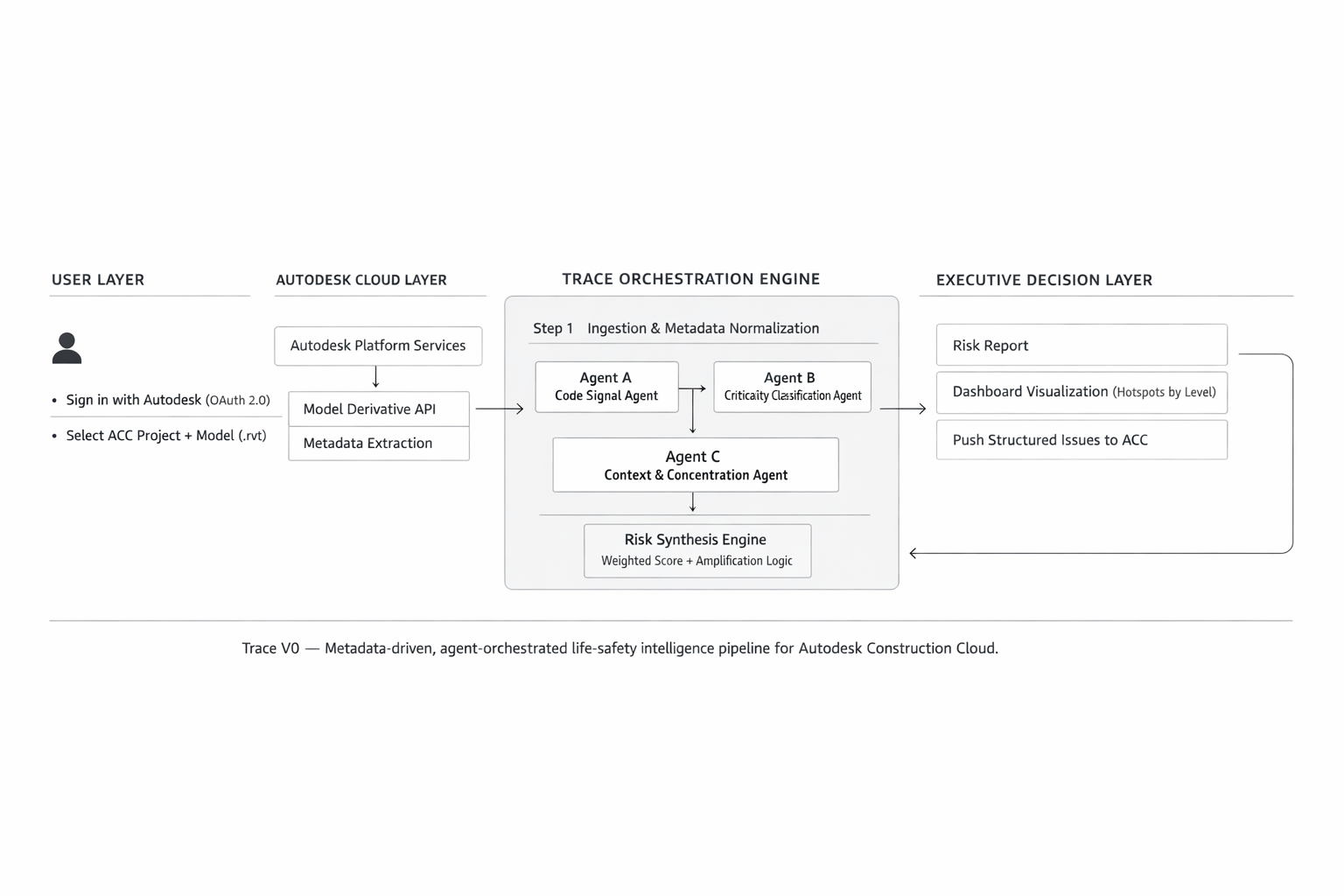
Trace V0.
ACC → Metadata → Agents → Orchestrator → Risk Report → ACC Issue
-
BIM managers and AEC professionals spend excessive time manually parsing dense model data to verify compliance and identify life-safety risks. There is a massive opportunity to leverage AI to shift this workflow from manual checking to automated intelligence orchestration.
By building a seamless integration with Autodesk’s existing environment (BIM 360 / ACC), Trace can drastically reduce manual review time, prevent costly downstream oversights during construction, and empower managers to focus on critical decision-making rather than data hunting.
-
Beyond the Chatbot
AEC professionals do not need another chat interface.
They need structured signal clarity.Agentic Architecture
Instead of one monolithic AI, Trace operates as:
Orchestrator of Agents. In V0, the system begins with three core agents Each agent processes a different intelligence layer.The Orchestrator synthesizes outputs into a unified Risk Report.
Trust & Explainability
In regulated AEC environments, AI must be accountable.
Given my research background in trust within virtual systems, Trace is intentionally designed to be explainable and auditable.
The system emphasizes:
Traceable reasoning chains (how a signal was generated)
Transparent categorization (severity × criticality logic visible)
Confidence signals (cluster amplification and weighting logic exposed)
Clear remediation pathways (structured issues pushed to ACC)
-
Merges intelligence from A + B + C into a single Risk Report.
For each signal from Agent A:
1. Look up criticality from Agent B for the same element
2. Compute weighted_score = severity_weight × criticality_weight
3. Check if signal is part of a cluster from Agent C
4. If clustered: weighted_score × amplification_factor
5. Sort all findings by weighted_score descending
6. Group by zone/level
7. Compute overall risk = f(weighted_scores, cluster_count, failure_rates)
8. Generate narrative summary
-
1. User selects ACC project + model
2. Ingest Layer pulls element metadata via API
3. Records normalized → stored
4. Orchestrator dispatches to Agent A + Agent B (parallel)
5. Agent A returns compliance signals
6. Agent B returns criticality weights
7. Orchestrator dispatches to Agent C (sequential — needs A+B)
8. Agent C returns risk clusters
9. Orchestrator synthesizes → Risk Report
10. Dashboard renders report
11. User [ in V0: BIM manager] approves → issues pushed to ACC
-
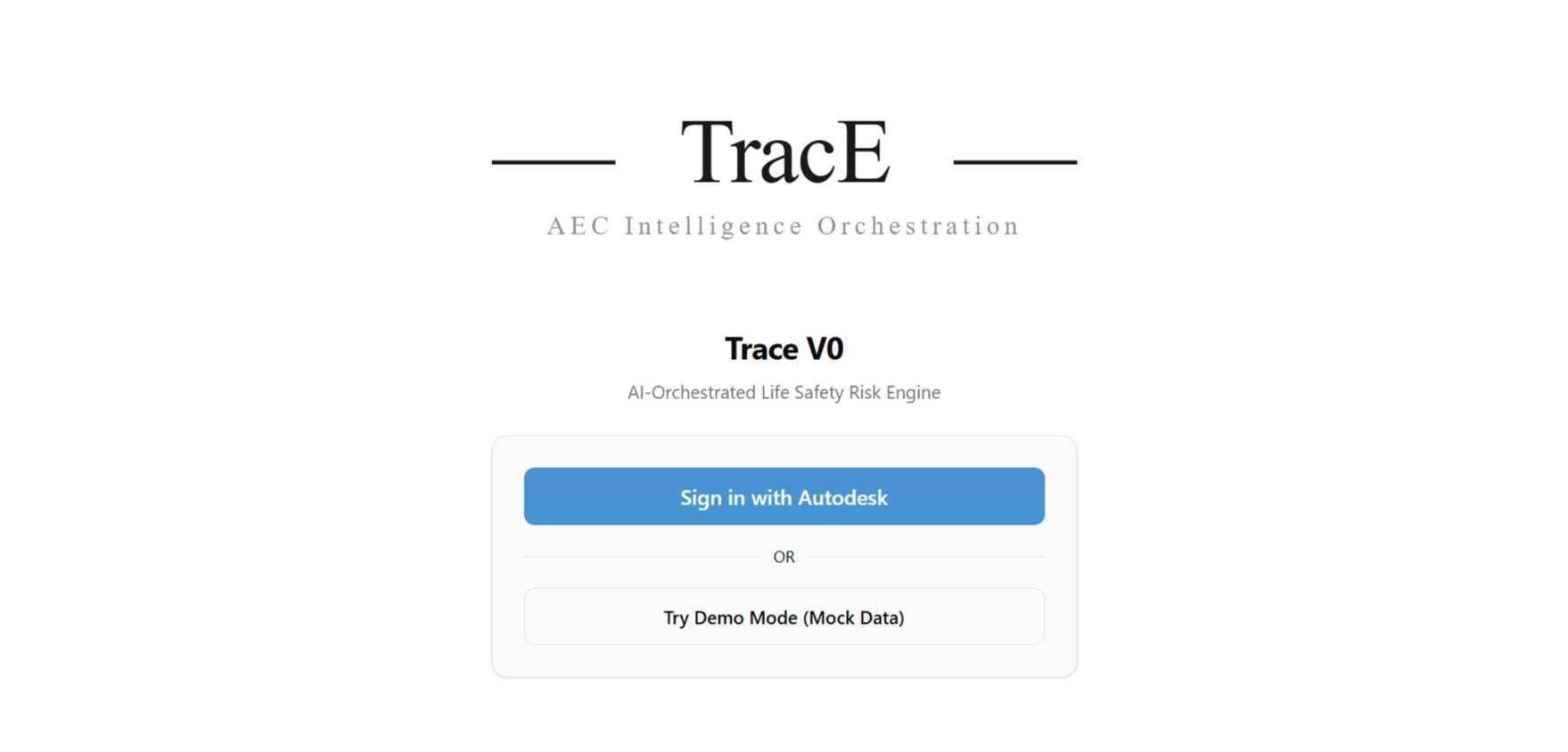
Frictionless Authentication: The user signs in seamlessly using their Autodesk credentials, securely authorizing the application to access their ACC Document Management hubs.
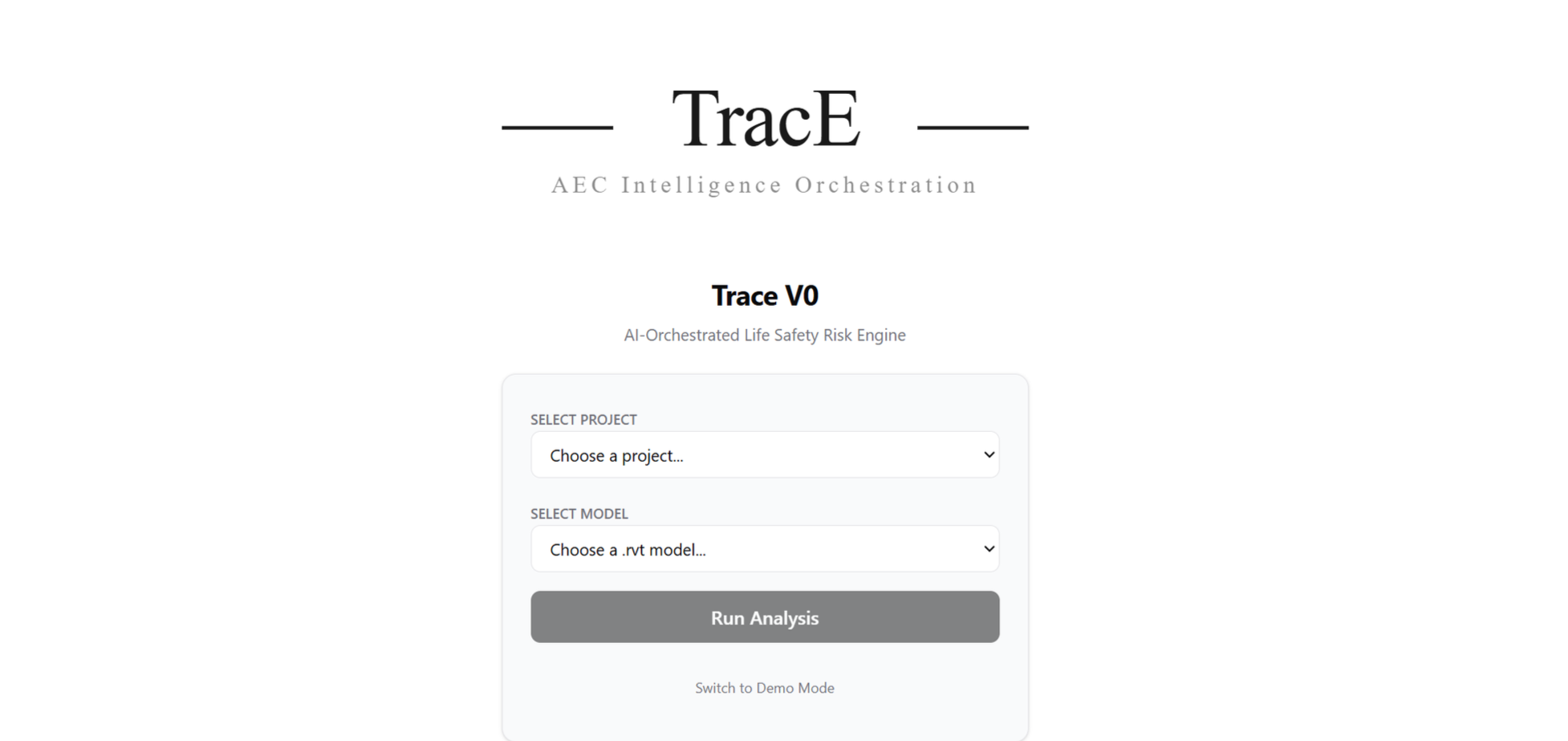
Native Asset Selection: A clean picker interface allows users to naturally navigate their ACC structure to select their project and target Revit model.
Orchestrated Analysis: Upon initiating the analysis, the app provides real-time progress while asynchronously polling Autodesk APS for translations and routing the payload through the AI pipeline.
Actionable Review: The user is immediately presented with a highly visual, graded risk report highlighting critical clusters and hotspot levels, allowing BIM managers to target non-compliant design elements before they reach the job site
-
Seamless Autodesk ACC Integration
Automated Ingestion & Translation
Multi-Agent Risk Pipeline
Executive Risk Dashboard
-
Developed a functional, production-ready MVP that successfully authenticates with Autodesk's ecosystem, ingests real BIM data via the Model Derivative API, and translates raw architectural elements into an actionable, AI-driven risk report.
The platform serves as a powerful proof-of-concept demonstrating how targeted intelligence orchestration and modern UX can sit on top of Autodesk Platform Services to solve complex, high-value AEC workflows.